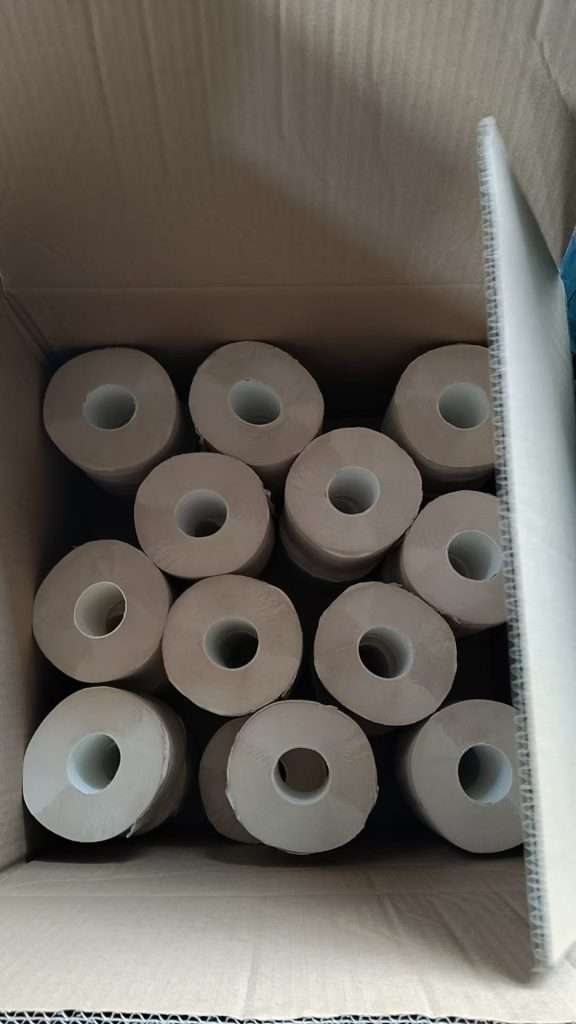
Process essence: The roll paper produced by our company has undergone standard embossing processing. This process creates a regular three-dimensional raised and recessed structure on the paper surface through precisely coordinated embossing rollers.
Optical principle: This structure directly alters the light reflection behavior of the paper surface. The raised parts of the embossing and the depressed areas/substrates form reflective surfaces with different physical properties
Raised surface: The fibrous structure is fluffy and expansive, generating stronger diffuse reflection (Diffuse Reflection) for the incident light. The direction of the reflected light is dispersed, thus visually presenting a relatively light and bright tone.
Base surface: The fibers are arranged relatively closely and evenly, and the light reflection is more concentrated (closer to mirror reflection). Under the same lighting conditions, it visually presents a relatively deep tone.
This difference in light reflection rate caused by the variation of the microscopic geometric shapes on the surface is the physical basis for generating visual contrast between light and dark.
Cutting method: We use high-precision rotary shear cutting technology to complete the cutting of the paper rolls. The movement trajectory of the round knife causes the cutting end face to form a small arc-shaped section instead of an absolutely 90-degree vertical section.
Structural exposure: This curved section will simultaneously and completely expose the multi-layer structure of the paper thickness direction. For embossed paper, this means that on the cutting section, the raised parts formed by the embossing will alternate with the original flat layers inside the paper along the radial direction of the paper roll.
Visual effect synthesis: When you observe the cut surface from the side, due to the inherent reflectivity differences between the “raised part” and the “base part”, alternating light and dark visual stripes are formed on the section. This is not due to uneven color dye penetration or humidity differences, but rather a true and regular visual presentation of the stable physical structure within the paper under a specific cutting angle.